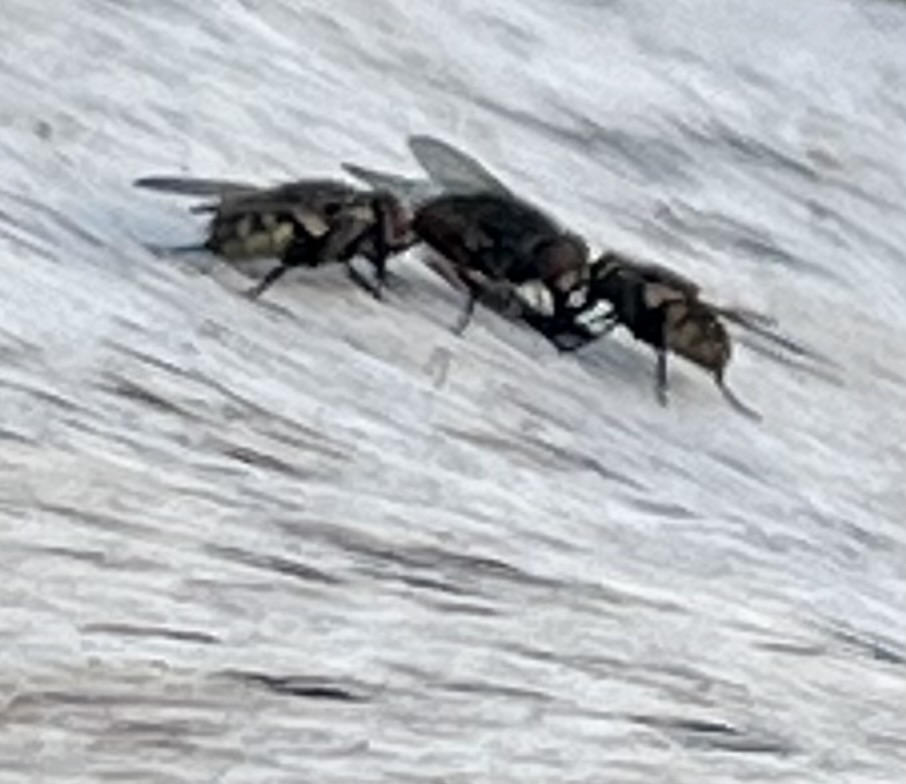
Summer has hit, and with it has come fly season. This pesky little bug has no personal space. He leaves little black spots everywhere and, depending on his mood, will bite. I generally live and let live with most insects. But, as far as I’m concerned, mosquitoes and flies are opponents to be slaughtered on sight.
Flies get into everything. Eating outside becomes an exotic dance as we wave our hands to keep them off our food while trying to eat. If a person is really unlucky, he finds that one has chosen to swim in his drink.
Being familiar with the irritation of flies, I found a verse in Ecclesiastes not only relatable but thought provoking.
Dead flies putrefy the perfumers ointment, and cause it to give off a foul odor; so does a little folly to one respected for wisdom and honor.
Ecclesiastes 10:1 (NKJV)
What a word picture. Dead flies. Great! The best kind of fly in my book. Surely, this annoying little bug is something that could be picked out. Instead, we are told that this is a big deal. This has passed from an annoyance to a real problem. The dead insect putrefies the perfume. What was being made to create a beautiful smell, an appealing scent, now smells rotten.
The dictionary defines the adjective form putrid as “having the odor of decaying flesh; very low quality; rotten.” The fly in the ointment creates this result. I know nothing about the ancient art of making perfumed ointments, but I completely understand the image.
Imagine you are the perfumer. You have followed your recipe precisely. This ointment you are creating has taken time, effort, and expense. It is ready for sale, but somehow, flies get in. Did you forget to close a window or perhaps a lid? Did you get distracted? Who knows. But what is clear from the stench is that you’ll never be able to sell this batch. You will have to start over.
We can identify with the horror followed by frustration the perfumer must have experienced, but the gut check is in the parallel that’s drawn, “so does a little folly to one respected for wisdom and honor.”
“A little folly.” What is that exactly? Folly is foolishness. Some foolish things are big and obvious. But others are much more subtle. They can be as simple as the words we let slip out of our mouths. Poorly chosen. Thoughts that should not have been shared. Foolishness can be a financial decision not thought through. They can be that wrong thing we know we shouldn’t do but take the risk anyway.
It is interesting to note that the impact of foolish behavior is worse for the person who has a reputation for being wise and honorable. It takes less to ruin them than the person who is already of low quality character. Expectations for the latter are already low.
Perhaps you know the disappointment of watching someone you admire fail in some way. The preacher cheated on his wife; the teacher was caught falsifying scores; the policeman stole evidence; the judge took bribes. Or maybe it was smaller – a parent who didn’t really listen to what you were saying, the youth pastor who gave judgment when you needed compassion. Whoever it was, you understand the impact of their foolishness on you and others. You may have never trusted them again. Everything they did and said after that was looked at through a cynical lense.
I have had foolish moments. I have pulled the blade toward me while cutting something. I have bought stupid stuff for stupid reasons. I have said things I shouldn’t have. I have given advice when compassion was needed. I have spit out spiteful words. I have been prideful. In other words, I have had more moments of foolishness than I could ever count.
A few of those I got away with. Some had only minor consequences that I’m aware of. But there are those that my heart still sinks in shame as I recall them. And nearly all of those have to do with the words I let out of my mouth.
I think about that image of the perfumer. Perhaps, she has many jars. That would make sense since she is selling to lots of people. Maybe the flies only get into a few of the jars. Is it possible she would sell them without knowing? I don’t know. But whoever gets the putrid ointment knows. Not everyone is affected, but her reputation as a perfumer is ruined with that one person. Perhaps she has a chance to make it right. Perhaps not.
There are times I can think of that my foolish words may have ruined my reputation and worse made a scarring impact on someone else. Who knows what the long term effects have been? I don’t know that I classify as a person of wisdom and honor, but I know that there are those who will wrinkle their noses at the thought of me.
We will never be perfect, which means we will say and do foolish things. This does not mean we get a pass. We like to say “I’m only human” as if that excuses our faulty behavior and somehow nullifies it’s consequences or at least our responsibility for the consequences. This verse in Ecclesiastes sets the record straight on that point. We do screw up, but we don’t get to just shrug our shoulders. The consequences are real, and sometimes they smell like rotting flesh.
I think two important ideas sit before us in this moment. The first is, if we’ve had a moment of foolishness that has impacted another, what will we do about it? Is there anyway we can sincerely apologize and make restitution? Sometimes.
If there is, we must take it. We must humble ourselves and apologize. I speak from experience. This is hard, and complete restoration doesn’t always occur. That doesn’t make it any less important to do. This act of humble repentance is about changing our own hearts, not someone else’s opinion of us. It is about calling wrong, wrong. Refusing to cover up the stink we created.
The second is, how can we pursue living wisely so that these moments of foolishness aren’t as frequent? As a Christian, my reputation matters for it reflects on God. After all, how many people use Christians’ poor behavior as an argument against God?
Proverbs 9:10 gives us a jumping off point. “The fear of the Lord is the beginning of wisdom…” Honor, respect and seek to walk in obedience to God. That will get us moving in the right direction. Because ultimately, that little bit of foolishness really is a big deal.


Leave a Reply