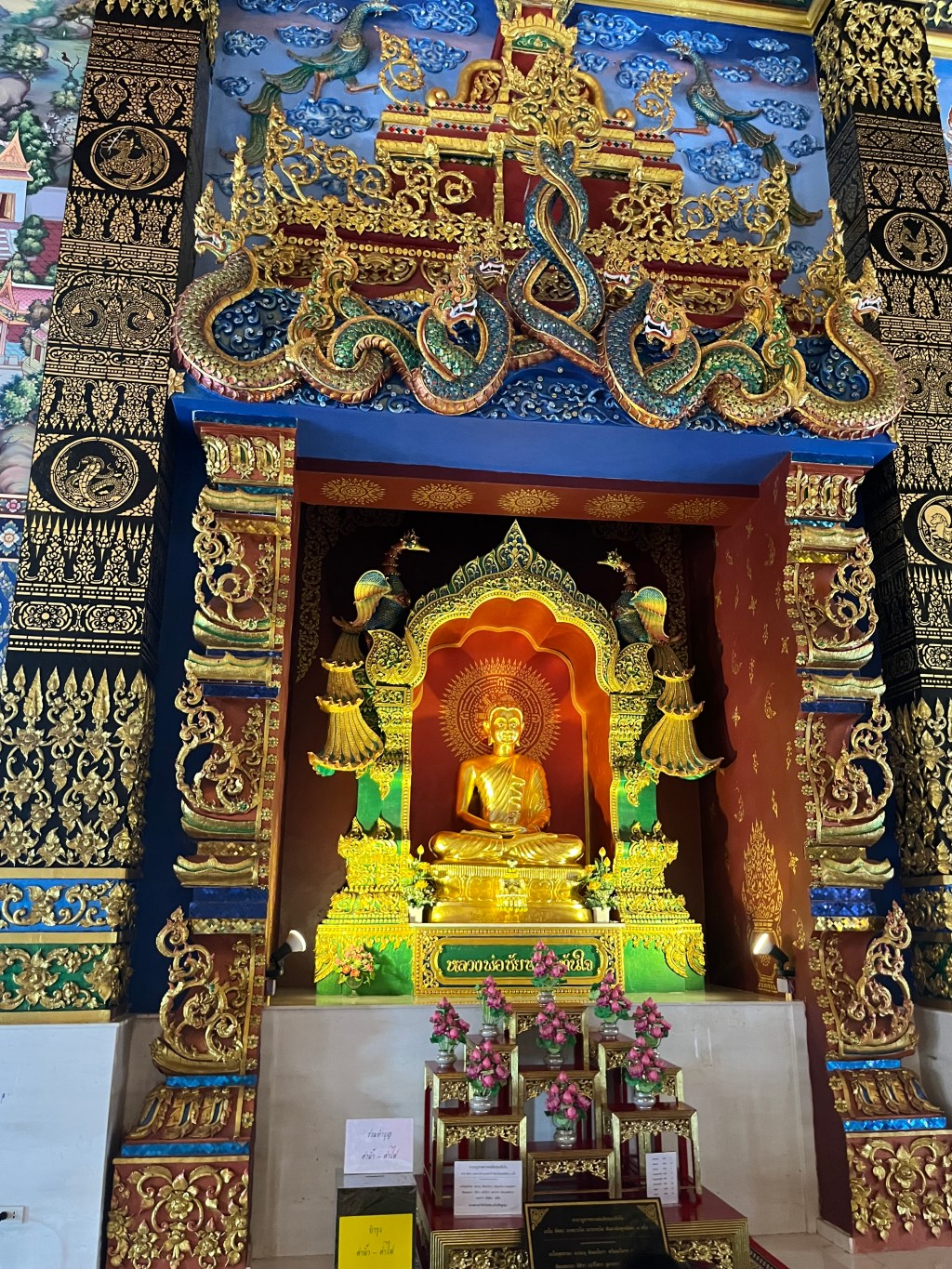
Two and a half years ago I was able to go to Thailand with some of my family. Thailand is absolutely beautiful, and I found the people warm and welcoming. As it is anytime you travel, there’s a bit of a culture shock. The climate, food and language are different. In this case even the script they used for language was different. Perhaps the most striking difference however was the religion. Instead of spires of churches dotting the landscape, temples and shrines and large idols were everywhere.
We visited a number and learned a little about Buddhism and Hinduism. We saw lots of statues of Buddha and a few of Ganesh, sometimes in the same place. In each case people left all sorts of gifts from money and little gold leaf pieces, to flowers and even food. Worshippers could be seen lighting incense and kneeling in prayer, making requests for things or at least asking that evil be kept away. This was my first encounter with a culture so seemingly different from my own.
Recently, I was challenged to reevaluate that difference after listening to John Lennox, a well known apologist and mathematician. He was doing a talk on Daniel. In the midst of the talk he briefly discussed idols, and he said something that caught my attention. “In the ancient world, idols were not things people loved. They were things people trusted.”
That gave me something to chew on. For awhile now, I’ve been thinking about idols as things I loved, in the sense that when I give priority to something over God, that is a form of loving it more than God. And I don’t think that is completely wrong, but when I think about trusting something in place of God, I gain a new perspective.
It turns out that with that definition in mind, the western world is full of idols. We don’t offer incense to them; though, it can be argued that we do offer money. When the question is posed, “Where do I put my trust?”, the idols seem to light up like neon signs posted across our lives.
Probably the first one is the easiest to spot. Money & possessions. We sort of acknowledge that chasing money is a bad idea, but then we take the promotion, or work more hours, or spend like a caffienated three year old on credit all because we think we need more things. The average American is roughly six times wealthier than other global adults. Yet, we quickly are dissatisfied with what we have and look to the next thing.
I’m not saying that earning money is bad. I’m saying that we are using wealth to enhance our sense of security. We trust in it. What if we had a Job like experience, and all we owned was taken from us in a single day? Losing a job or losing everything in the stock market has resulted in more than one suicide. Where do we put our trust?
This may seem counterintuitive, but those who have money probably struggle more with this than those who don’t. When you have plenty, forgetting who your Provider is is only too easy. You easily begin to believe that your money will protect you. When you are scraping by, you are in a better position to recognize your dependence on God. How generously we give can be an indication of what we value.
Another idol that we might find in our own lives is health and strength. The younger you are, the more likely you are to worship this idol. For you are convinced, like every human before you, that you will always be able to go and do with very little effort. As the aches set in and the going and doing becomes a bit more difficult, the first response is often one of shock coupled soon afterward with a sense of betrayal. More than one person has felt betrayed by their body when it failed them in some way.
Still there is this sense that we can power through it, fix it. After all, we have access to great medical care, compared to much of the world. We have all sorts of preventative medicines and practices designed to protect us and extend our lives. I am not saying that we shouldn’t take care of our health or that exercise is wrong. But again, if we are struck with a terrible disease, are we devastated? Whether our strength is ripped away from us little by little or in one fell swoop, our response reveals where our trust is.
Appearance is not a new idol but has seen exponential growth in the last few years. People have long looked for the fountain of youth, but now the masses are pursuing it with great vigor. (I discuss this in my post Birds & Botox). Leaves wither and flowers fade, but somehow no wrinkles are supposed to arrive on this face. When we spend more time, money, and attention on our appearance than we do on seeking God’s kingdom, we need to ask ourselves where our trust is. The prettiest in the casket is still dead.
For most of us our comfort zone becomes an idol in one form or another. For many this idol is one of control. We trust in our ability to control *fill in the blank*, and we avoid anything we can’t. We refuse tasks God invites us to join Him in because we don’t …leave the country, speak in front of people, pray aloud, fly in a plane, eat food beyond our experience, drive after dark, go to a new place, talk to people we don’t know…etc and etc and etc. We stick with what we are comfortable with because we trust it.
Another way the comfort zone shows up as an idol is in the way we approach things we don’t want to do. We work hard all week and don’t want to give up sleep for church on Sunday. We know that doing x,y, or z is important, but we aren’t really comfortable doing that, so we don’t. What we don’t want dictates what we will do rather than what is right before God. Again, we trust our desires above all else.
Our own knowledge, skill, abilities, and experience can quickly become things we put our trust in. Depending on my own understanding and abilities was a constant temptation as a teacher, especially as my experience increased. The battle was constant to remind myself that God was my source of creativity, understanding and discernment.
Are we truly teachable? Will we work and advise out of our own wisdom, or will we choose to trust God’s? When we begin to think we hold all the answers and that our way is best, we have some flashing lights warning us of idol worship. (Note: seeing these in others is far easier than than spotting them in ourselves.)
Most of us, on some level, put our trust in the approval of others. We bask in the glow of praise and shrivel when anyone criticizes. We can be tempted to use it to determine our self worth or even if we are making right or wrong decisions, rather than recognizing our worth as created and redeemed by God and standards of right and wrong set by Him.
This next one you may initially want to argue with: people. Oh, you probably agree that putting your trust in people in general is a bad idea. How many government leaders have let us down? We even understand that friends let us down. But I’m including all people in this: parents, spouses, children as well as self. What I am NOT saying is “don’t trust anyone.” Rather, our hope and security should not rest wholly on any one person. When it does, that person has become our idol. Ultimately, we can withstand the betrayals or loss of others when our trust is in God. If someone else is your “rock,” I want to challenge you with the thought that Jesus is our rock and firm foundation. This does not devalue the importance of someone in your life. Thank God for them, but don’t put them in place of utmost importance.
A dear man I know recently lost his wife after fifty plus years of marriage. He was always convinced, with fairly good reason, that he would go first. In the first moments of her death and in the days immediately following, he repeatedly asked God to take him too. He felt the loss so keenly. But after two weeks, he came before the church and asked for prayer. His request revealed that he was setting aside the temptation to idolize his wife and her companionship. He revealed that he had realized that if God had left him, it meant that his time wasn’t finished. His prayer had changed and was now that God would reveal what he needed to be doing with his time left.
I included self in the last category because messages like “trust your heart,” “self care,” “be true to yourself” and others permeate our culture now. But self has always been the preeminent idol of the heart. Pride is insidious, and self works its way into multiple categories already discussed.
This blog is not long enough to capture all the idols out there. I could easily include tradition, science, and rational thought as well. I am sure there are others. I challenge you to go through that list and consider how we put our trust in each of those.
What we need to understand is that none of these things; money, strength, appearance, approval of others, people, skill, science, rational thought, etc, are bad in and of themselves. To think so would be foolish. Each are excellent tools when wisely handled. However, each can easily slide into a position of idol, something in which we trust.
American money is still inscribed with the words “In God we trust.” Do we? What idols are we throwing money and/or time at and metaphorically offering prayers to? God takes idol worship seriously. “You shall have NO other gods before me” (Exodus 20:3). In the Old Testament, those who feared God, tore down altars to false gods and cut down the idols. What idols need to be torn down in our lives?
Most of these I have listed have been awfully close to idol status at various times in my life. Sometimes, I find I have to pull down again and again the same idols in my heart. So this is not a post to wag my finger at you. I want you to know I am in the fight with you. I am your sister in arms fighting her own battles and calling out to you that I see an enemy approaching from behind. Be aware. Ask God to reveal what idols He wants you to tear down, and ask Him to give you the courage to do so. “Trust in the LORD with all your heart and do not lean on your own understanding. In all your ways acknowledge Him, and He will direct your paths” (Proverbs 3: 5-6).
If you find this or any of my posts helpful or challenging, please feel free to share them with a friend.
 A Cup of Grace - with a shot of espresso
Leave a comment