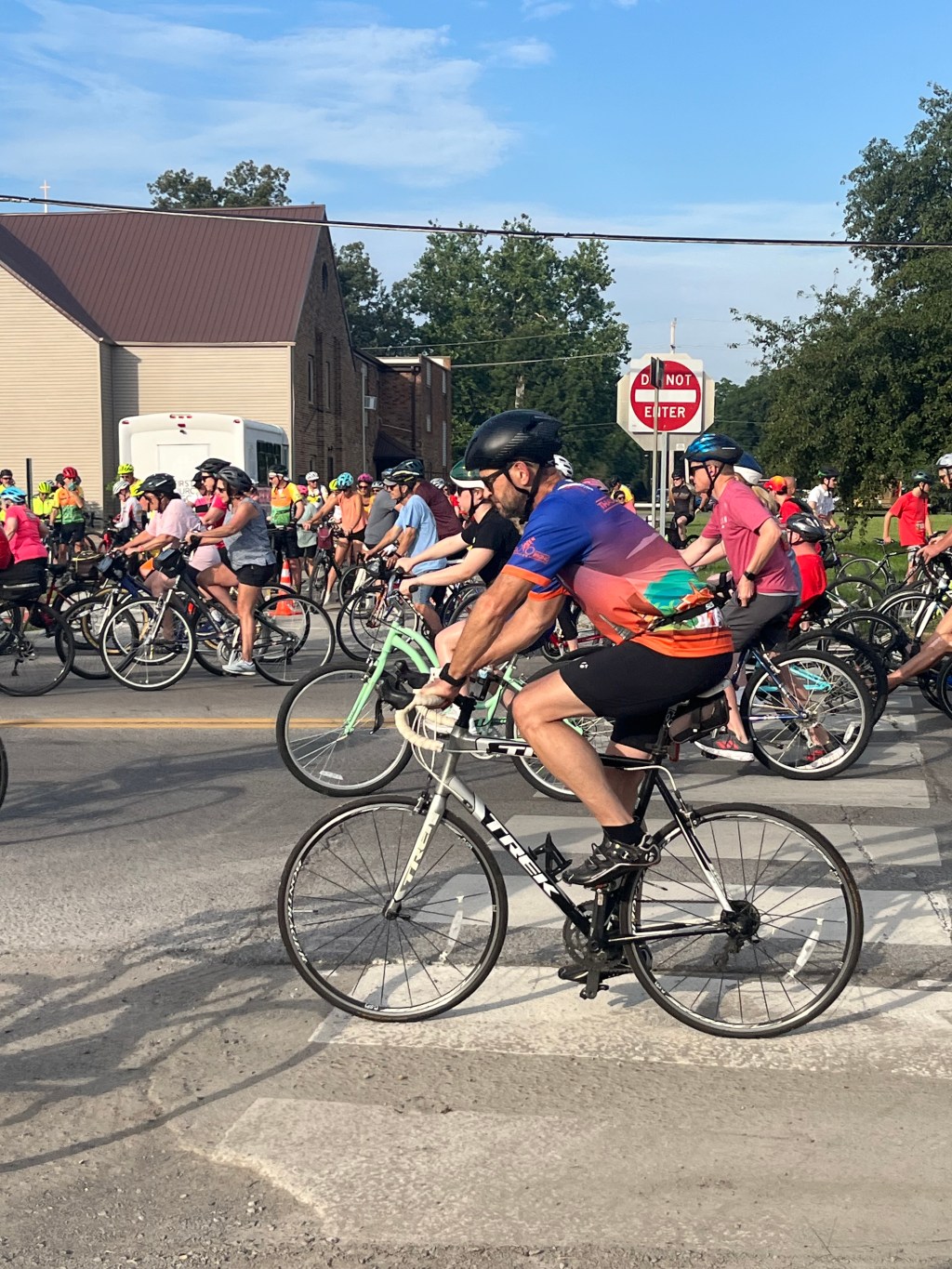
My husband loves to trail bike. He zooms down the bumpy, tree rooted trails with enthusiasm. He pumps hard with joy to get to the top of a steep climb. He sees ledges as an opportunity to fly for a second. He trusts the bike to do what it’s designed to do. I, on the other hand, do not.
Terror fills my heart as my bike picks up the slightest speed, and I’m immediately cranking down on the brakes. I believe that if I slow down, I will have more control. My grip tightens at every root and rock. I jerk the handlebars wildly for a gentle curve because I am convinced that I am going to plow into a tree. If I make the curve, I end up walking uphill because I do not have the courage to charge the downhills
All of these attempts at tightening my control have the opposite effect, and they completely rob me of the joy of riding. I do not experience the exhileration my husband does. And one accident, due to my own attempts to control, has only increased my fears exponentially.
In fact, this fear has leaked into biking in general, so much so that about a year ago I was barely able to complete a ride with my family along paved trails. My brain said, “This is silly.” My heart said, “Boom! Boom! Boom!” with growing intensity. My brain said, “You’re over reacting; try breathing.” My palms broke out into a cold sweat and my arms shook. My brain said, “Take it easy. It’s just a a hard left turn.” My arms said, “Nope. Nope. Nope!” and tried to steer multiple ways at once.
Never have I felt so out of control of myself. The more I tried to control my reactions, the worse it got. There was nothing logical about it, and that made me angry and embarassed. Even now, just picturing the trail (which was a wide sidewalk!) results in my heart rate spiking.
I have never been “comfortable” on a bike, but I have been able to ride. Several years ago, I even participated in a local event called The Tour de Corn. I rode thirty miles! Crowds and potholes made me uneasy, but I could do it. However, after that trail bike accident which left my leg with a big scar (again due to my tendency to overreact), my fear escalated to unreasonable heights. I do not trust myself not to jerk the handlebars right into oncoming traffic.
I know that part of the answer is getting back on a bike, and I intend to, though probably not on a trail. I would need some serious therapy I think to attempt that. However, many of us have fears that are based on “not having control.” Our grip on our lives and those within it becomes ever tighter, but we aren’t really any better or any more at peace for it.
You know, we live in a pretty “safe” environment overall. Oh, it has some dangers, but we aren’t really afraid of starving or freezing to death. Nor do we believe that at any moment an invading army will come burning all we own and skewering us in the process. Most of us live in locations where we don’t even fear being eaten by some predator. Truth is, we rarely even have to endure being “too hot” or “too cold” for any length of time. Modern medicine and improved health practices have removed our fear of many diseases that used to sweep through humanity (small pox, bubonic plague, polio, measles, mumps etc.). We, mostly, live far longer than our ancestors.
All of this has given us the illusion that we are in control of far more than we are. In a sense, I’m pretty sure that our generally controlled environment has actually made us more susceptible to fear and anxiety. We aren’t faced with real risks, and so we’ve come to fear smaller risks.
The irony is that the more we try to control life, the smaller our world becomes. Our refusal to accept what we cannot control, often causes us to refuse to participate. We tighten our grip, afraid of anything that might be even uncomfortable. We refuse to fly, to go places we aren’t familiar with, to try foods we don’t know, to talk to a stranger, to be too hot or too cold, the list goes on and on. As parents, that can leak into our parenting. Our fears begin to dictate what we allow our children experience.
But even our control of our children is limited. And our control of anyone else is, in truth, not in our grasp either. We can influence them, but we cannot control them in a way that is healthy for us or for them. That said, some want control so badly they will use force or manipulation as a form of controlling others. We generally recognize those as mentally and emotionally unhealthy practices.
So where do we consider God in all of this? Do we understand that He is ultimately in control? He has granted us free-will. We can choose to give that back to Him, to submit to His authority, or we can choose to go on in our tiny power struggles. How’s that working so far?
Trusting God does not mean we will always be “safe” – not in the way we think of safety. Trusting God does not mean that our plans and desires will come to fruition. Trusting God means acknowledging that His plans and desires are good – even when we don’t understand them. We can’t see the big picture, so how can we possibly understand the importance of the dark that sometimes shades our lives.
Proverbs 3:5-6 says, “Trust in the Lord with all your heart, and do not lean on your own understanding. In all your ways acknowledge Him, and He will direct your paths.” (NKJV)
So what is “trust”? Trust is more than a state of being. It is an action. I can say I trust you, but if I’m always questioning what you are doing or following your every move, that’s not trust. Do you really trust God? (I think for most of us the answer is “sometimes.”)
Verse 5 continues to tell us what trust looks like: “do not lean on your own understanding.” If you’ve been a parent, or even a babysitter, you have probably run into a circumstance where a child must trust you. You could give an lengthy explanation as to the why you are asking them to do or not do something, but they wouldn’t understand it, or maybe they wouldn’t believe you. After all, sticking a fork into a socket doesn’t look dangerous, and since I’ve had little to no exposure to being shocked, I don’t really understand what that means. We are adults and likely fairly intelligent; however, God sees what we do not. He understands what we do not.
Verse 6 goes on, “In all your ways acknowledge Him…” Note the “all.” In everything you think, say or do, “acknowledge” Him. I don’t think “acknowledging” here is a simple wave, “Oh, hey there, God” and going about our business. The NIV uses the words “submit to Him” instead. This is really the idea of taking God and what He says into account in every area of your life.
Verse 6 then continues with a promise. “…and He will direct your paths.” Many translations use the phrase, “He will make your paths straight,” some even go so far as to say “smooth and straight,” yet, I think this can give us the idea of “easy.” Scripture as a whole does not support this belief. Psalm 23 references that sometimes our Shepherd leads us through “the valley of the shadow of death.” Jesus, himself, clearly trusted the Father’s plan, and the path wasn’t easy. Jesus also told us that following Him would be just the opposite. “Take up your cross and follow Me.”
I think the more accurate way to view this is to know that when we acknowledge God in every part of our lives, when we let His ways dictate ours, we aren’t left wondering what to do. In other words, when we trust God with things like truth over lies, forgiveness over bitterness, purity over pleasure, thanksgiving over complaining, etc, He is showing us the path to walk. Again, let’s be honest; these are often the more difficult paths to choose. But when we “acknowledge God” we aren’t left dithering over which is the right choice.
However, our desire to control the “situation” or to simply do what “feels right” to us can send us into a spiral of unintended consequences. We seem to believe that we know better than He does. God asks us to look to Him instead. Do we trust Him enough to seek to please Him first and foremost?
How many times have you, or someone you know, chosen what “felt right” or what seemed to put us in a better place in a situation, failing to take God into account? Perhaps, we believe that we know better than He does. However, the downstream results are often painful to watch. Frequently, they are years in the making.
Life isn’t easy or even really “safe.” I do believe in “healthy fears,” so you won’t find me jumping in front of a moving vehicle to see what happens. The question is, where in my life am I failing to trust God with the outcome, even if it’s one I don’t think I want? Where is my “need for control” leading me to think and behave in a way that is counter to Him? Can I echo Christ’s words just before He went to the cross, “Not my will but Yours be done”? That is the ultimate release of control and an act of complete trust.
 A Cup of Grace - with a shot of espresso
Leave a comment